
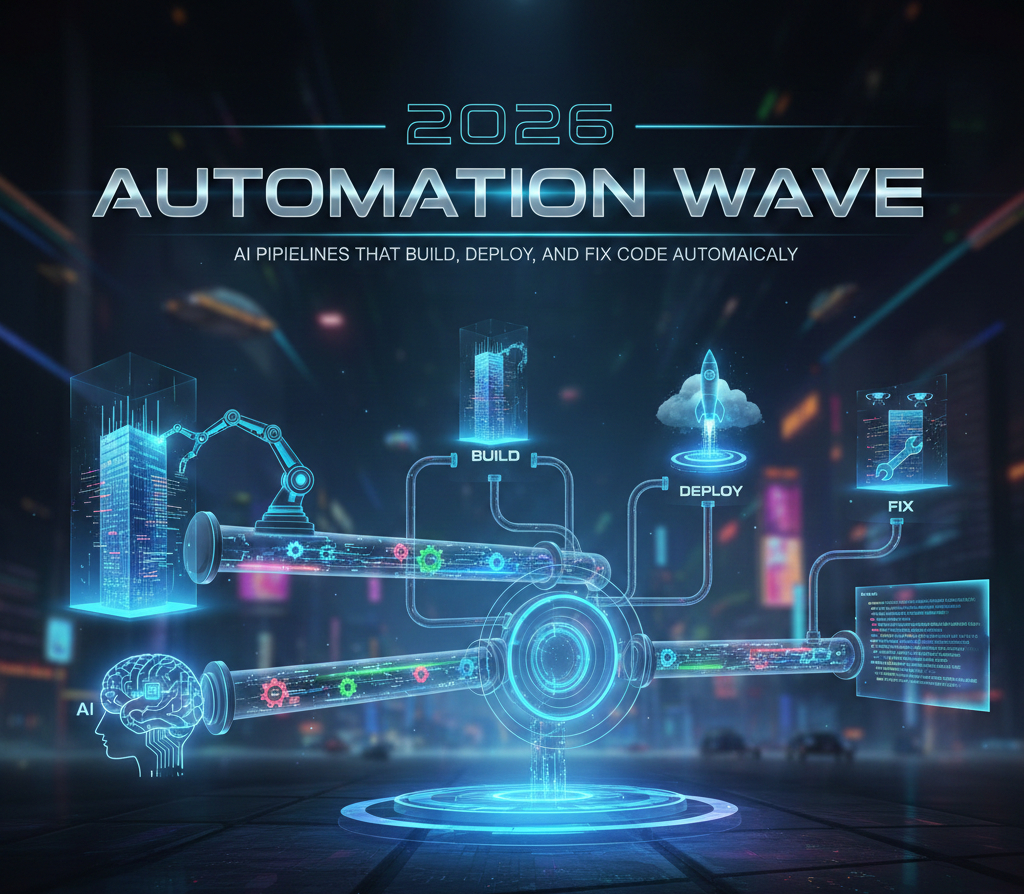
2026 Automation Wave: AI Pipelines That Build, Deploy, and Fix Code Automatically
The way we build software is changing fast, and 2026 is shaping up to be the year where AI takes over DevOps completely. What used to take engineering teams days or weeks — writing code, testing, deploying, debugging — can now happen automatically through AI-driven pipelines.
This isn’t sci-fi anymore. Companies are already replacing traditional CI/CD setups with Agentic DevOps Systems, where AI agents handle everything from feature creation to deployment and troubleshooting.
Let’s dive into how this new automation wave works, why it’s taking over, and how your business can start using it.
What Is an AI Automation Pipeline in 2026?
In simple terms:
An AI automation pipeline is a system where multiple AI agents work together to:
- Generate new code
- Run testing
- Deploy to production
- Monitor issues
- Fix bugs automatically
- Roll back if needed
These agents think, communicate, and execute tasks just like developers — but 24/7 and at insane speed.
They’re powered by advanced LLMs, reasoning engines, graph memory, and real-time tool access.
Why 2026 Is the Breakthrough Year
Three major breakthroughs came together:
1. On-Device LLM Runtimes
Models run locally on machines, CI servers, and cloud workers, removing latency.
2. Agent-Orchestrated Workflows
Tool systems like CrewAI, OpenAI Dev Ops Agent, and GitHub Copilot Agents allow multiple AI workers to collaborate.
3. Self-Healing Infrastructure
Servers auto-detect issues and trigger AI patches without human input.
This combo created the perfect environment for full DevOps automation.
How These AI Pipelines Work (Step-by-Step)
Here’s a breakdown of a typical 2026 AI-powered DevOps flow:
1️⃣ Feature Request → AI Planning Agent
You type:
“Add a dark mode toggle to the user dashboard.”
The planning agent:
- Analyzes the repo
- Checks dependencies
- Creates a task graph
- Assigns subtasks to coding agents
2️⃣ Coding Agents Generate Code
Multiple agents collaborate:
- One creates components
- Another updates state logic
- Another updates tests
- Another runs static analysis
All using repo-aware context (no token limits).
3️⃣ AI Testing Agent Runs Automated QA
It performs:
- Unit tests
- Integration tests
- UI snapshot checks
- Performance checks
- Security scanning
If an issue appears, it automatically fixes it.
4️⃣ Deployment Agent Pushes to Production
Once tests pass:
- Deploys to edge/cloud
- Runs smoke tests
- Verifies version integrity
If something fails, rollback happens instantly.
5️⃣ AI Monitoring Agent Watches Everything
It monitors in real time:
- Logs
- Errors
- Latency
- Crash rates
- Security anomalies
If an issue appears, it patches the code automatically and restarts the pipeline.
Real Example: Self-Fixing Bug
Imagine an API endpoint failing.
AI Observes the Error
ERROR: Unexpected null value in OrderService
AI Debug Agent Response
- Identifies the error
- Finds root cause in file
- Applies a patch
- Creates a PR
- Runs tests
- Deploys the fix
All without developer intervention.
This is becoming the new normal.
Benefits for Businesses
1. 60–80% Faster Development
AI handles repetitive and complex workflows instantly.
2. Lower Engineering Costs
One developer + AI agents = full team output.
3. Fewer Production Downtimes
Self-healing systems reduce incidents.
4. Perfect Documentation
Every change is auto-documented.
5. Higher Code Quality
AI consistently writes clean, tested code.
Which Tools Dominate in 2026?
AI DevOps Agents
- GitHub Copilot Dev Agent
- OpenAI Code Runner
- Anthropic BuildAgent
- Llama CodeOps Suite
Automation Platforms
- CrewAI Orchestration
- LangGraph Operations Mode
- Airplane AI Pipelines
- Vercel + Edge Agents
Self-Healing Infra Tools
- Datadog AutoPatch
- AWS Lambda Autorepair
- Cloudflare AI Worker Watchdog
This stack is becoming standard.
Where This Is Going by 2027
Expect:
- Zero-touch deployments
- AI-owned microservices
- Agents negotiating workloads
- Entire apps being maintained automatically
- Developers focusing on ideas, not code
Basically: Engineering becomes managing agents, not writing code manually.